Muriel Siebert Makes the NYSE Co-Ed

by Mary Goljenboom

Although there is no rule against them, the floor of the Exchange has been better protected against women members than that of Congress.

That’s Eunice Fuller Barnard’s opinion of opportunities for women at the New York Stock Exchange (NYSE) from her 1929 article “Ladies of the Ticker.” She goes on to describe what seems to be an impossible barrier to women members.

A woman . . . could not just buy a seat. As in any club, she would have to be admitted by vote of the membership committee. And it seems doubtful whether either she or they yet desire her presence . . . .

That barrier worked for almost forty more years. During that time at least one woman was said to have tried to buy a seat. Her bid was ignored. But in 1967 the barrier was finally broken. Muriel “Mickie” Siebert finally had all the necessary requirements to purchase an NYSE seat: desire, established ability and experience, money, and, most importantly, support of two members.

In her autobiography, Changing the Rules, Siebert told how she made the New York Stock Exchange co-ed.

“It took me six months to summon up the nerve to apply.” During that time she considered the risks and rewards, and compared the levels of potential aggravation to satisfaction. “It’s hard to imagine that any man would have been troubled by similar doubts and concerns, but, realistically, I had to consider what I was risking” she said. She was already a very successful securities analyst with a strong client list of institutional investors to whom she provided both research and suggestions about securities purchases and sales.

Siebert, like all other applicants, put up twenty per cent of the seat’s purchase price as a deposit and had arranged financing (using stocks she owned as collateral) for the remainder; found two NYSE members to sponsor her (a difficult task); underwent a background check by a detective agency; and was interviewed by the admissions committee. Parts of Siebert’s application process were not standard. She was required to present a letter from her bank stating that it was prepared to loan Siebert the necessary funds to complete the purchase of the seat. One of her sponsors was asked what he knew about Siebert’s private life. During the admissions committee interview, Siebert reported seeing the committee’s relief upon learning that she would not be working on the NYSE floor.

It was evident that the NYSE did not wish to admit Siebert to the “club,” and it did what it could to dissuade her from completing the process. But the exchange could not ignore her application (as it did with at least one earlier female candidate) and, because of her strong qualifications, it could not afford to vote her down. Why? Because members knew that Siebert would sue and the law was on her side. Title VII of the Civil Rights Act, which outlawed sex-based discrimination, had taken effect in 1964.

Whether or not the majority of members of the New York Stock Exchange desired the presence of a female colleague, they got one on December 28, 1967.

Siebert died in August 2013. In her life, she changed rules and made it easier for women to rise in their chosen professions.

Sources
Changing the Rules by Muriel Siebert and Aimee Lee Ball

“Ladies of the Ticker” by Eunice Fuller Barnard. The North American Review, Vol. 227, No. 4 (Apr. 1929), pp. 405-410, Stable URL: http://www.jstor.org/stable/25110719

Copyright 2013 Ferret Research, Inc.
Young-Quinlan Reflections

by Mary Goljenboom

Finding pieces of women’s business history sometimes requires that you look up.

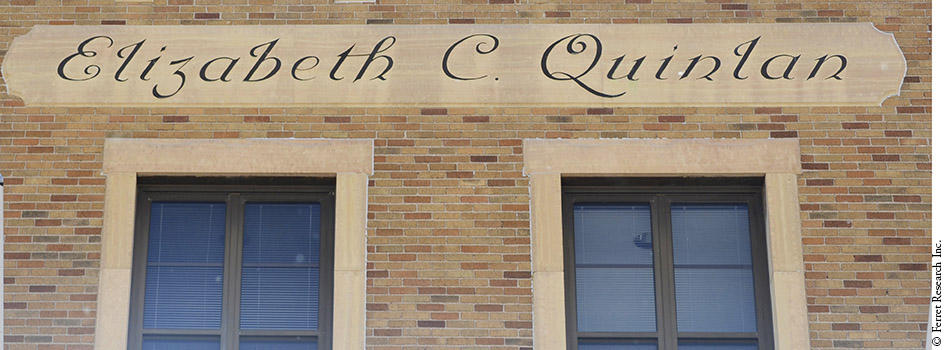
For instance, in downtown Minneapolis, if you stand on the Nicollet Mall outside the Target store and look across the street, you’ll see the historic Young-Quinlan Building. Look up above the third floor windows and you will see “Elizabeth C. Quinlan”, the name of the businesswoman who built both the building and the business that was housed in it.

exterior of  the Young Quinlan Bldg, Minneapolis,

Young-Quinlan Company opened its doors in March 1895 as Fred D. Young & Company, selling women’s clothing. Fred Young had left his position as manager and buyer for the cloak department of another popular Minneapolis store to start his own business. Elizabeth Quinlan joined Young in his new venture. She was well-known to customers, judging by Young’s mention her in pre-opening publicity and advertising. In 1903 her name was added to the business.

Young and Quinlan’s great innovation was to stock their shop with high quality, ready-to-wear clothing at a time when most clothing was made individually by dressmakers. The team also benefited from the growing personal wealth and affluence created by burgeoning Minneapolis and St. Paul businesses such as Pillsbury, General Mills, and the Northern Pacific Railroad. To attract upper-income customers, the Young & Co.’s opening day ad announced “the finest line of imported and domestic cloaks, mantles, suits, separate skirts, and waists ever seen” in Minneapolis. According to Elizabeth Quinlan, they sold out most of their merchandise on their first day. And they never strayed from stocking the finest.

By the time the Young-Quinlan Building was opened in 1926, Elizabeth Quinlan had been with the company for more than thirty years. She had been sole owner and president since the death of Fred Young in 1911. The business grew significantly so that by the 1920s, Quinlan saw its need for more space. She purchased the land at Nicollet Avenue and Ninth Street South for $1.25 million; the $1.25 million she needed to erect the building was financed by issuing bonds (which sold quickly because her credit was so good). The elegant new Young-Quinlan building was filled with walnut fixtures, stairs, cathedral windows as well as modern conveniences like a 250-car parking garage and elevators. It reflected the success and taste of Elizabeth C. Quinlan, who put her name on the Nicollet facade, above the third floor windows.

Quinlan sold Young-Quinlan Company in 1945, and it lasted until 1985. The landmark Young-Quinlan Building today prominently houses J.B. Hudson jewelers. Reflected in the glass door into Hudson’s, you can catch Target’s bulls-eye logo. Young-Quinlan’s merchandising innovation of providing women with ready-to-wear clothing eventually revolutionized the apparel industry and led to the rise of mass merchandisers like Target. It’s a glimpse of the future reflected from the past.

Y-Q Target bullseye

Copyright 2013 Ferret Research, Inc.

Mary Vail Andress

by Mary Goljenboom

In 1924, Mary Vail Andress was hired by Chase National Bank to be an assistant cashier, thus becoming the bank’s first female officer. She left the Paris office of Banker’s Trust Company to take the position at Chase. Bankers magazine included the following information about Miss Andress’ new job:

“Miss Andress will be associated with the main office of the bank and will occupy a desk on the officers’ platform together with the other operating officials. It is understood that her duties will be the same as any other official of similar rank. This is a most forward step in the position of women in banking . . .”


A most forward step . . . a woman, hired to a position currently occupied only by men, expected to do the same job as the men.

Andress held her position with Chase for fifteen years, until 1940 when she left to help the war relief efforts in Europe.


Notes
In December 2013, Sotheby’s auctioned a Cartier enamel, diamond, and gold compact inscribed to Mary Vail Andress from Bankers Trust Company, Paris. View the Sotheby’s catalog entry.


Copyright 2013 Ferret Research, Inc.

Mildred King Archibald

by Mary Goljenboom

Over time, the stories that make up our history sometimes change. Usually they are modified to be simple and concise. Often in business history this means that women’s roles are diminished or ignored entirely. One example: Mildred King Archibald of Fannie May Candies.

A quick internet search lists the founders of Fannie May Candies as “H. Teller Archibald and his wife, Mildred.” Mr. Archibald is always listed first. We are left with the impression that he was the primary force in starting the business and that his wife’s role was secondary. She helped, taking on responsibilities under his management and guidance. But in a 1928 interview in the Chicago Daily Tribune, Mrs. Archibald tells the story in a slightly different way:

We opened our first shop on La Salle Street . . . with a small amount of capital and in a small way. Our kitchens were in the back room of the shop. Mr. Archibald continued his real estate business, with the shop only as a side line. But the business grew. One shop seemed to lead to another and almost before we knew it we had a chain store system.

While her husband worked primarily in his real estate business, Mildred Archibald “was willing to work night and day” to see the candy shop succeed. And succeed it did. When the first Fannie May shop opened in 1920, the business was one of about two hundred candy or confectionary manufacturers in Chicago. Even with all that competition, three years later Fannie May Candies had ten shops. While it is unclear when Teller Archibald joined the business full-time, it is clear that Mildred’s full-time efforts got the business up and running successfully.

Interestingly, later in the interview she says “But please don’t think that I am entirely responsible for the success of this business. I should much rather give the credit to my husband, who is president of the firm, and my brother, who is manager of the kitchens.”

Modesty? Perhaps. Social convention? Maybe. Within nine months of the published interview, the Archibalds’ marriage was over. Newspaper reports say that part of the strife came from differences of opinion on the business. The divorces (there were two: one in Florida and one in Illinois) were acrimonious; when all was finally settled, Mildred received $1 million (about $13 million today), in part to repay the money she invested in starting up Fannie May Candies. Teller kept the business. Thus, when the story of the founding of Fanny May is told, his name is always listed first.

Sources
Chicago Daily Tribune, February 19, 1928

Copyright 2013 Ferret Research, Inc.

Working Mothers circa 1940

by Mary Goljenboom

Shirley Polykoff faced the difficult choices most working mothers struggle with today. She was a working mother in the 1930s and 40s.

In the midst of the Depression, I had borne two daughters. And in the next ten years I had experienced all the problems of trying to hold onto a career so that the family wouldn’t notice that I had one (although my daughters have since assured me that they certainly did notice) and to handle the home so that it wouldn’t appear to the career that there even was a family that might make any claims on my attention.

Who was Shirley Polykoff?

Today she is remembered as one of the most successful advertising copywriters of her time and, in 1959, the first woman elected vice president of the Foote, Cone & Belding agency. The famous Clairol hair color slogan, “Does she . . . or doesn’t she? Hair color so natural only her hairdresser knows for sure,” is Polykoff’s. But in the 1930s and 40s she was a young woman constructing a career in advertising, a marriage, and a family.

As a young married couple, Polykoff and her husband, George Halperin, tried to find the roles that fit their personalities and aspirations. Halperin’s law partners “did not find it seemly” that a wife should work, so, for a time, Polykoff attempted the role of stay-at-home wife and mother. It was not satisfactory for the family and in her autobiography she describes how they ended it. “George was very patient for about two weeks. Then one evening he came home with flowers. ‘Listen, sweetie. You make a lousy little woman in the kitchen.’” Polykoff happily returned to advertising work. She figured out ways to juggle work and family, including hiring nannies to assist her.

Obviously much has changed since Polykoff and her husband made their decisions about work and family balance. As a society we still need to improve the supports available to workers with family obligations. In this area there is no “one size fits all”. The supports that former Yahoo’s executive Marissa Mayer can afford to put into place—building a nursery next to her office—are available to those of us working from home but not those of us working from company cubicles. Flexible schedules and workplaces and good child- or elder-care options are vital.


Source
Does she … or doesn’t she? : And how she did it by Shirley Polykoff


Copyright 2013 Ferret Research, Inc.